For most human storytelling, audiences are innately interested in what happens inside the characters’ minds while they’re in action. We want to know their motivations and their options. We need to know the why and how our favorite characters arrived at any particular moment in the story. We call this the “interiority” and, in my opinion, it’s the very substance of art.
We are now, according to the latest research from Flux Trends, living in a “complicated attention economy” where more than 94% of viewers use a second device while watching television. The smartphone has transformed communication into what trend analyst Dion Chang called in 2008, a “mezzanine level of communication: somewhere not quite engaged, but also not quite ignoring people,” and the consequence is a fundamental restructuring of how stories are told. Streaming platforms, driven by data and the imperative of “bingeability,” engineer content specifically for what Netflix executives term “second-screen viewing.” In other words, shows designed to be followed by an audience whose primary focus is elsewhere. As Lauren Zalaznick, the former NBCUniversal executive, observed with prescient clarity, “our audiences have audiences of their own” . We are no longer watching alone; we’re watching while performing for digital crowds, while scrolling, while shopping, while existing in two places at once, and narrative itself has bent to accommodate us.
But bend, as any solid material knows, is not the same as break. And in the bending, a handful of shows illustrate that the only way to survive the attention economy is to demand, rather than beg for, our full presence. Chief among them is Severance—a series that has become a kind of training ground for a mode of attention thought to be lost.
Stranger Things and the Fear of the Unspoken
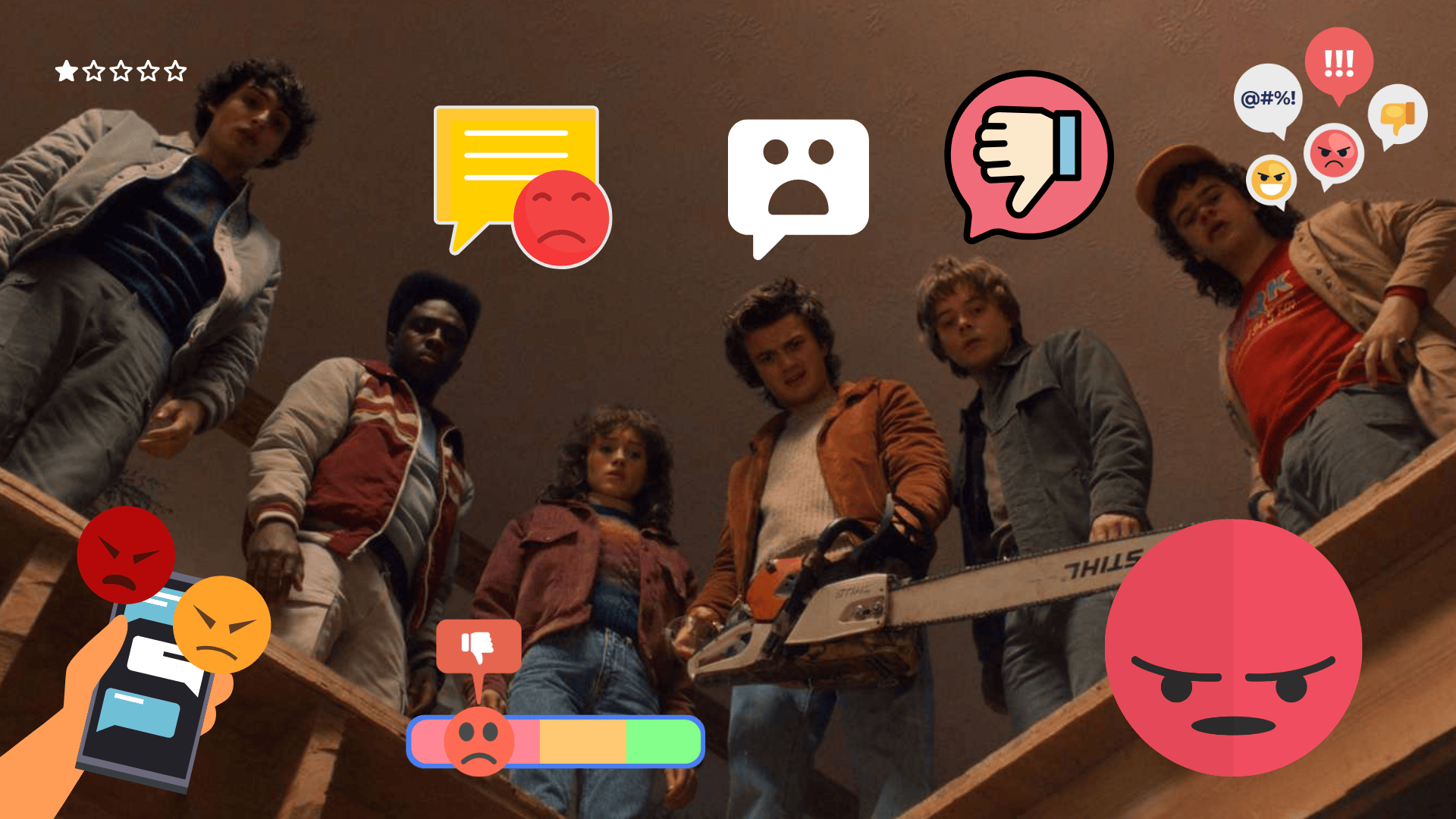
When the final season of Stranger Things premiered in December 2025, it was met with something stranger. Instead of uproarious applause, as we all expected of the intense fandom, die-hard fans across the globe expressed their utter disappointment in the 8-episode conclusion of the series, dropping the once lauded Netflix Original’s Rotten Tomatoes audience score to a series-low… 57 percent. The flashpoint was a scene in the penultimate episode, “The Bridge,” in which Will Byers (Noah Schnapp) finally articulates what audiences had suspected for years: he’s gay and realized it after recognizing that he’s in love with his best friend Mike.
On its surface, the backlash appeared to be the familiar culture-war skirmish over “wokeness.” Elon Musk declared it “completely unnecessary and forced on an audience that just wants to enjoy some basic science fiction.” But beneath the predictable outrage, a more nuanced critique emerged—one that cuts to the heart of how we now consume narrative. As one fan wrote on X, “The forcing of everyone into a room to sit and be quiet then listen to every awkward word that came out of Will’s mouth when most already knew and didn’t give a f—k because they are trying to save the world” .
USA Today‘s Kelly Lawler articulated the aesthetic failure more delicately, noting that while Will’s coming-out “could have been triumphant and inspirational, it ends up being underwhelming and awkward.” The Duffers, for their part, defended the scene as the most carefully crafted moment of the series—one they spent months writing and co-directing, one that required Noah Schnapp to reach into the deepest parts of his own experience. “It’s rare,” Ross Duffer said, “but sometimes there are moments where you’re like, ‘We just won’t capture that again’.”
But here is the uncomfortable truth that the Duffers’ defense elides: they did not, in fact, capture it at all. They captured something else entirely—a scene that felt, to a significant portion of their audience, not like the culmination of a nine-year arc but like an arbitrary insertion, a checkmark on a inclusivity to-do list rather than an organic flowering of character. And the fault lies not with an audience too distracted to appreciate depth, but with storytellers who may fundamentally misunderstand the relationship between interiority and plot.
The scene’s narrative scaffolding collapses under even gentle scrutiny. Will comes out, we are told, because Vecna has been using his secret to “spy” on the group—a threat that might have carried weight had the show ever established its mechanics or stakes. How exactly does Vecna weaponize a closeted crush? What specific tactical advantage does his omniscience gain from knowing that Will loves Mike? These questions go not only unanswered but barely even asked. The scene exists in a narrative vacuum, tethered to the plot by the thinnest of threads. Will states his fear of Vecna using his crush “against him” on a few occasions during the season, but we’re never shown how that bit of information could be of any use to Vecna. When that thread snaps—as it immediately does, with Vecna’s defeat having nothing whatsoever to do with Will’s self-acceptance—the scene floats away entirely, a heart-warming irrelevance.
The Duffers claimed that Will’s coming-out was “the ultimate ‘f— you’ to Vecna.” But a gesture only constitutes an act of defiance if the opponent is capable of feeling the sting. Vecna, as written in the final season, evinces no awareness of Will’s revelation, suffers no setback because of it, and is ultimately defeated by Will’s mother, Joyce, in a battle that renders Will’s entire emotional journey dramatically inert. The scene becomes a lone scene that desperately tried to add some humanity to a plot that mistakenly over-relied on ‘action’ to create emotional responses. The irony is exquisite. In reaching for interiority, the Duffers produced something that felt, to many viewers, like a mechanical gesture toward depth that revealed, in its execution, how thoroughly they had forgotten what depth looks like.
The contrast with previous seasons couldn’t be more stark. Earlier iterations of Stranger Things understood that character and plot are not separate tracks but a single braid—that what happens to people and what happens inside them must be the same thing. The show that once built its mythology around the correspondence between Will’s emotional state and the Demogorgon’s depredations—that understood his trauma as literally world-shaping—somehow forgot that correspondence in the final hour. As one student publication observed, “The queerbaiting surrounding Will and Mike was another aspect of the show that felt incomplete and misleading… After seasons of buildup, elements of Will and Mike’s storyline felt pointless if the Duffers were never intended to complete it.” Noah Schnapp himself reportedly had to ask the Duffers to write in a single brief scene between Will and Mike to provide some kind of resolution—a request that suggests the creators had, astonishingly, planned to leave even that thread dangling.
This failure of follow-through helps explain why “writing a better ending” became a trending topic on TikTok in the weeks following the finale. The audience, it turns out, knew these characters better than the writers did. They had spent nine years absorbing the show’s visual language, its emotional grammar, its idiosyncratic logic. They understood that Will’s arc required a grand culmination woven into the very fabric of the climax. They recognized, with the intuition of the deeply invested, that the scene “added nothing to the plot” —not because they were incapable of appreciating interiority, but because they knew, even without the help of professional analysis, that this interiority had not been earned and didn’t pay off in its own right.
The accusations that followed were brutal but, in their way, diagnostic. Many reviewers noted that the final season felt so starkly different from its predecessors—so mechanically plotted, so tonally inconsistent, so strangely indifferent to the characters’ established trajectories—that they began to suspect the involvement of ChatGPT. Screenshots from the behind-the-scenes documentary One Last Adventure, in the fans’ opinion, appeared to show ChatGPT and Reddit tabs open during writing sessions and fans seized on the imagery as explanation for what they were witnessing. “The Duffer brothers really used ChatGPT for this script? WTF,” one fan wrote. “No wonder why the finale felt different and incomplete.” Whether the AI accusations hold water is almost beside the point; what matters is that they felt true to an audience experiencing a season that seemed generated rather than authored, or seemed more like telling than showing.
The tragedy of Will’s coming-out scene isn’t that the Duffers attempted interiority in an age hostile to it. The tragedy is that they attempted it poorly—that they mistook the dialogical acknowledgment of the character’s inner life for its dramatic realization. They failed to weave the personal into the apocalyptic and asked their audience to care about a revelation that had no consequences for the story they were telling. In doing so, they gave ammunition to those who believe interiority has no place in popular entertainment and they demonstrated how difficult it is to do well. The audience was not, as some defenders claimed, too distracted to appreciate depth. They were too intelligent to mistake its simulacrum for the real thing.
Game of Thrones and the Collapse of the Journey
If Stranger Things illustrates the audience’s impatience with interiority, Game of Thrones demonstrates what happens when the storytellers themselves lose faith in it.
Six years after the series concluded, the conversation has shifted from broad condemnation to something more diagnostically useful. As Catherine Delgado of comicbook.com recently reflected, “I still think the ending itself wasn’t the real issue,” she postulates. “Game of Thrones‘ biggest mistake was how it got there.” The final seasons, stripped of George R.R. Martin’s source material and apparently stripped of patience, began to move at a velocity that could no longer accommodate the kind of storytelling that had made the series great. “Without the books as a guide and clearly in a hurry to finish, the show got more shallow—and even more predictable.”

Comparatively, Daenerys Targaryen’s transformation from liberator to tyrant wasn’t, in itself, incoherent. As multiple critics have noted that the choice to make her a villain actually makes sense within the logic of her character, she is after all, a Targaryen. The problem was the compression. What should have been a gradual descent—marked by doubt, by self-deception, by moments of genuine moral struggle—became a sudden swerve. “Everything happened at once,” Delgado adds.”…like the show was checking off boxes on a to-do list instead of actually crafting a tragic arc.”
This is the pathology of plot-destination syndrome. It’s the belief that what matters is where characters end up, not how they get there. It’s the storytelling equivalent of second-screen viewing, in which the primary experience is elsewhere and the show itself becomes background music to the real drama of reaching the end. When viewers complain that Jaime Lannister’s redemption arc was “thrown away at the last minute,” they’re critiquing a violation of interiority. They invested in the slow, painstaking process of a man changing—and then were told that change could be undone in a single scene, because the plot required it. Instead of of showing us that Jamie is irredeemable, the writers give him a few lines of dialogue in the end that just tells us that the character won’t change. There’s no meaningful buildup and no meaningful explanation of his return to Circe’s side after everything he’s learned along the way. You could use this point to support the idea that the abrupt regression of Jamie’s character is a realistic point to make. That people don’t change. But the rest of the show spends several seasons developing the inverse of that theme.
What made the early seasons of Game of Thrones revolutionary was their willingness to let scenes breathe, to let characters simply be in conversation, to trust that politics and philosophy and human contradiction were as compelling as the dragons. “An entire episode could be just conversations—and we were hooked,” Delgado continued. But that patience evaporated when the destination came into view. The show that once understood interiority as the very substance of drama began to treat it as a luxury it could no longer afford.
Severance as the Interiority Counter-Reformation

And then there is Severance.
If Stranger Things and Game of Thrones represent, in their different ways, the triumph of plot over person, of velocity over depth, then Severance arrives as their antithesis—a show that is not merely uninterested in second-screen viewing but actively hostile to it. To watch Severance while scrolling is to watch nothing at all. The show does not yield; it demands. And in demanding, it offers a kind of salvation.
Created by Dan Erickson and directed with visionary precision by Ben Stiller and Aoife McArdle, Severance literalizes the very fragmentation that second-screen viewing produces. Its premise—workers who undergo a surgical procedure to separate their work selves from their personal selves—is a metaphor for the dissociated state in which we now consume media. We are all, in a sense, severed now, part of us watching, part of us scrolling, part of us performing for audiences we cannot see. The show’s aesthetic, with its “shiny, pristine, and completely unnatural set design” creating “an atmosphere of surgically-designed claustrophobia,” as Raian Abedin put it, mirrors the sterile compartmentalization of modern attention. The hallways of Lumon Industries are the hallways of our own minds. The endless, identical, and strangely comforting refusal to surprise us is delicately balanced with a primal vigilance against dark unknowns.
But Severance heals this fear wound that the show exposes in its audience by refusing to accommodate our fragmentation. As The Atlantic‘s Sophie Gilbert observed, the show requires a kind of attention that feels almost radical in 2026—the attention we used to give to novels, to paintings, to music listened to with eyes closed. Every frame is dense with information that can’t be absorbed passively. The color palette—that famous “Lumon blue” that seems to leach warmth from every scene—is semantic, carrying meaning about the emotional states of characters who have literally been surgically removed from the emotion that makes them human. The production design, which critics hail as a masterpiece of uncomfortable geometry, creates a visual language for interiority itself. The long corridors are the corridors of memory, leading us to big revelations of the self and the sterile offices are the tiny boxes we tend to use to cage our most primal dispositions.
What makes Severance revolutionary is its faith in the audience. It trusts that we’re still capable of the kind of attention that interiority requires. It trusts that we’ll notice when Helly’s eyes flicker with recognition she can’t explain. It trusts that we will sit with the silence when Mark stares at a photograph of his dead wife, and understand that everything—the entire mythology of the show, the entire weight of its philosophical ambition—is contained in that silence. Severance isn’t a show you can watch casually as you doomscroll. It inhabits you. You don’t finish an episode so much as emerge from it, blinking, unsure for a moment which world is real.
The second season, which premiered to widespread acclaim in early 2025, deepened this commitment. Where a lesser show would have begun answering questions, Severance continued asking them—and more radically, continued trusting that the questions themselves were the point. The “Woe’s Hollow” episode, set almost entirely in a snowy wilderness, was a masterclass in sustained tension achieved through absolutely nothing happening. Characters walked. They talked. They stared at trees. They remembered things that might not have happened. The episode was forty-seven minutes long and contained approximately forty-five minutes of what, in the grammar of second-screen viewing, would be called “dead air.” And it was, by consensus, the greatest episode of television in 2025.
This is the interiority. It’s an understanding that meaning accumulates in spaces between. It’s knowing that a character is an entire universe in miniature. It’s about illustrating that the most interesting thing about consciousness is not what it does, but what it feels like to have one.
The critics who initially dismissed Severance as “pretentious”, “self-indulgent”, or “slow” have largely fallen silent, replaced by a chorus of people recognizing that the show represents something genuinely new. It’s not slow, there’s just an immense amount depth. There’s a chasmic difference and we’ve forgotten how to tell. That forgetting and the remembering that Severance demands, is the central drama of our cultural moment.
The Attention We Deserve
What unites these three cases is a shared intuition that something has gone missing. The complaints about Stranger Things (too much exposition, too little action) and the critique of the Game of Thrones finale (too much velocity, too little consequence) are, paradoxically, expressions of the same hunger that Severance feeds. We want stories that hold us. We want characters who feel real. We want to sit in the dark and feel something other than the phantom vibration of our phones.
The second-screen phenomenon has significant anthropological implications, as well. The concept of has led to filmmakers and entertainment companies like Netflix intentionally dumbing down their content for audiences who are busy on their phones and watching ambient TV. These are the economics of unwatchable content. The creation of shows engineered for distraction, designed to be followed with 30% of our attention, calibrated to never demand more than we’re willing to give.
But 2026 is the year we shift back to analogue. The socio-cultural shift toward analogue living and privacy will be the saving grace of of the television show system. More people are opting to “log off,” to reclaim the kind of attention that interiority requires. Severance is on the front lines of this shift. The show has become a kind of cultural test. If you can watch it, really watch it, you are still capable of the kind of attention that makes art possible.
Severance, as a piece of art, understands this. It understands that the lighting on a face when no one else is watching isn’t a special effect, but the whole of the drama. It understands that what happens between the scenes isn’t filler but substance to be developed. It understands that we’re starving for stories that trust us to be fully present—and it feeds us, slowly, patiently, frame by frame.
This, perhaps, is the deeper significance of the debates surrounding these shows. When we argue about whether Will’s coming-out scene was necessary, whether Daenerys’s turn was earned, whether Severance is profound or pretentious, we’re also arguing about what we want from stories and what we’re willing to give them in return. Interiority isn’t a luxury. It’s the whole point. It’s what distinguishes art from content, what transforms information into experience, what makes us feel, in the darkness of the theater or the solitude of our living rooms, that we are not alone.
The question is whether we’ll still be watching when it does. But Severance, in its quiet brilliance, has already given us its answer. If showrunners will keep making the food, they can trust that we will find our way back to the table.
Discover more from Color Coded Magazine
Subscribe to get the latest posts sent to your email.