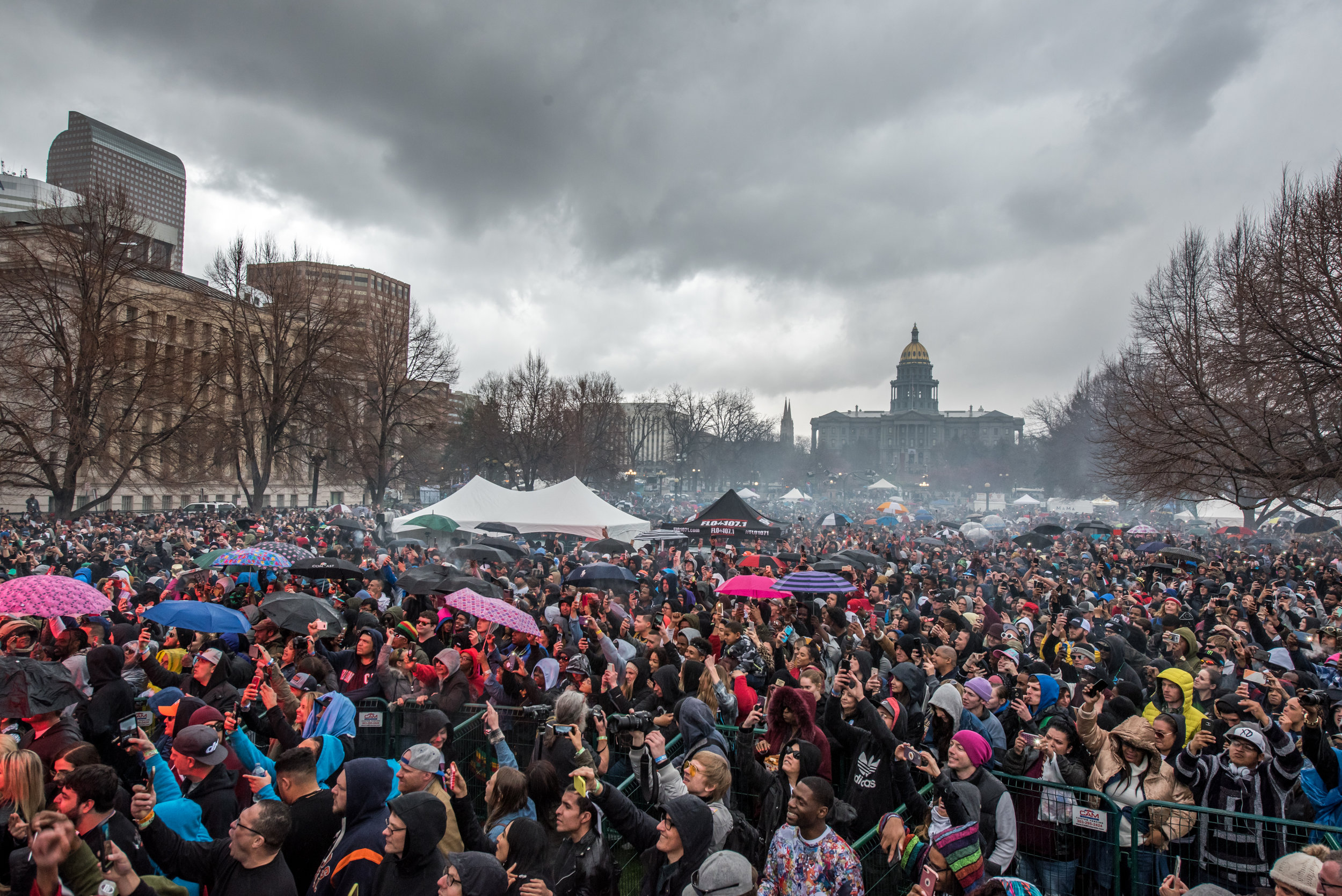
The 4/20 celebrations I remember were really just a gathering of hippies and stoners, singing “Kumbaya” and rallying for a cause. The annual festivities were clandestine and rebellious. You’d ditch school—in my case, North High—cross the bridge, cover your face with a mask so you wouldn’t end up on the news, and go listen to “people like ‘the Founding father of legal pot’ Rob Corry, and list of community activists speak on the Capitol steps. For better or worse, there was a cause people believed in.
Cannabis has always been part of Denver’s culture, especially within the Mexican and Chicano communities, something I can speak to directly. My grandmother made “snake oil” from the stems of the plant, used in ritual ceremonies with our Native families. Meanwhile, everyone in our communities had aunts, cousins, mothers, and fathers waiting on the weed man. The process of scoring cannabis at the time was a ritual in itself; the black market was a community.
Yes, there was a price that came with cannabis being an illegal substance, a price many of our family members paid with days of their lives. We’re not alone. Many of us grew up in the neighborhoods of Denver and the surrounding areas. We all understood the culture and were, in some ways, more connected because of it. But of course, we all wanted to be free to consume cannabis without fear.
In 2010, before the law changed in 2012, I worked at Casselman’s Bar and Venue, where the monthly MMBA meetings were kindling the fire of decriminalization. I also worked with Marijuana Radio (now defunct) and spent a good deal of time in the culture before legalization. I was one of the first edible critics for Kush Magazine, and in 2016 my article “The Green Rush” appeared in The Source issue #271. I can tell you from direct observation, the passion and fervor that fueled the pre-legalization movement has since been replaced by greed and bureaucracy. Innovation has met the cruel teeth of regulation.
What was once a platform for organizers and activists has become a corporatized caricature of itself—a way to make money. Don’t get me wrong: everyone loves a good concert and a chance to partake in the state’s unofficial flower, but there are still things to fight for. People with marijuana convictions are still in prison. Schools are still closing, funding issues still remain and teachers are still underpaid. Why isn’t Colorado leading the country in hemp production nearly fifteen years later? Why don’t we have consumption lounges everywhere? Why is there no banking system for the industry? Why isn’t the city building goods and services around this festival? Where is the Cannabis Museum to track this historic changes? In many cases, the companies in the state themselves are having a tough time with taxes and while in competition with corporations. As tax revenues wane and stabilize, we need to re-think the way the system runs.
Next weekend, people will flock to Denver on 4/20/2026 to pay $35 to $185 to attend a concert. But the industry is flawed. Outside of Tetra Lounge, there will be nowhere for them to legally congregate and consume. Think about that, people consuming cannabis do not have any legal, safe and open spaces to consume the state’s cash crop sold on almost every corner. Bureaucracy has strangled the system into a mass-consumption vehicle that is not serving the people. And yes, you should be angry. You should feel, as I do, that we were sold a lie, only to have it choked in political red tape.
As Justine Sandoval who is running for House district 5 said, ““I grew up in Colorado when 4/20 was about protest, not just partying. It was a call to legalize marijuana and fix unjust systems. Yes, we’ve made progress, but the work isn’t done. If we’re going to celebrate, we also need to be honest about what’s still broken and commit to fixing it.”
Former Commerce City Council member and Women of the Mountain member, Renee Chacon, echoes those sentiments, “It was security. It was teaching how elders and youth were in the middle while everybody surrounded them just in case they got a little bit too wily like they have been now. It was organized. And now I see these protests like they’re festivals. I don’t need a 420 Coachella Colorado. I need a community that recognizes we did not get all of our asks. We still have Black and Brown people in the prison pipeline. We still have predominantly a White owned Cannabis industry, especially here in Colorado. I live in Commerce City. They’re (dispensaries) almost becoming like gas stations. So that’s all they invested in that space in Commerce City. And when we have environmental injustice continuing to go on.”
She brings up a great point. Colorado should be leading the pack in hemp production and multi-faceted uses. Hemp can be made into 60,000 textiles including fertilizer, and help can help heal the soil from pollutants. The fact that hemp cannot be grown outdoors in rural Colorado is absurd. Hemp can be used to create sixty thousand different textiles. While we worry about the homeless population, we could literally make them clothes, shoes, and even houses out of cannabis waste—yes, read that line again. Hemp production should be far more developed in Colorado by now.
A city like Pueblo could be transformed into the hemp center of the state and the nation for that matter, where all waste converges to be processed and turned into anything. But what keeps that from happening is the same thing that derails everything good—the same thing that ruined the early promise of Uber, Turo, and Airbnb: greed and bureaucracy. We have to stop letting the top ten percent of money earners control and ruin everything.
Our people locked up for crimes that are now daily transactions deserve our attention. Our general citizens deserve the Colorado made products that can be created from the waste. Our unhoused neighbors deserve options we can build from hemp.
The discussion after this opinion should not diverge into semantics about the current law or processes. It should end with only one question: Do we all deserve better?
Discover more from Color Coded Magazine
Subscribe to get the latest posts sent to your email.